
I’ve repaired more e-bikes in the last two years than I did in the previous twenty combined. That tells you everything you need to know about where cycling is headed, and it also tells you that a lot of people bought e-bikes without fully thinking it through.
Not because e-bikes are bad. They’re not. Some of them are genuinely brilliant machines that have gotten people riding who never would have otherwise. But I’ve also seen people spend two thousand dollars on an e-bike that’s completely wrong for their situation, and then they sit in my shop looking confused when I explain that their battery replacement is going to cost as much as a regular bike tune-up every year for the next five years.
So here’s the honest breakdown. When an e-bike makes sense, when it’s a waste of money, and what you’re actually signing up for if you buy one.
The Math Nobody Does Before Buying
Here’s what most people think when they buy an e-bike: “I’ll save money on gas.” And that’s true. But the full picture is more complicated and most people don’t bother working it out before they hand over their credit card.
Let me run you through the real numbers. A decent e-bike for commuting runs somewhere between one thousand and two thousand five hundred dollars, depending on what you’re after. Then you’ve got the ongoing costs that nobody mentions in the sales pitch: battery replacement every three to five years (three hundred to six hundred dollars), tires that wear faster because you’re going faster, brake pads that wear faster because you’re carrying more weight, and occasional electrical issues that your local bike shop might or might not be able to fix.
Compare that to a car: gas, insurance, maintenance, parking, depreciation. Even a cheap car costs five to ten thousand a year to run. An e-bike costs maybe five hundred to a thousand in a bad year. The math isn’t even close if you’re replacing a car.
But if you’re replacing a regular bike? The math gets murkier. A five hundred dollar commuter bike costs almost nothing to maintain. An e-bike costs more in batteries, tires, brake pads, and the occasional motor hiccup. You’re not saving money by switching from a regular bike to an e-bike. You’re buying convenience, which is fine, just be honest about it.
The honest math: if you’re replacing a car, an e-bike is a financial win. If you’re replacing a regular bike, it’s a lifestyle upgrade that costs more to maintain. Both are valid. Just know which one you’re signing up for.
When an E-Bike Makes Perfect Sense
You’ve got a commute over five miles. Five miles on a regular bike is fine, most people can do that in 25 minutes without breaking a sweat. But ten miles? Fifteen? That’s where an e-bike transforms the calculation. What was an hour of hard riding becomes 35 minutes of comfortable cruising. The motor doesn’t do the work for you, it just makes the work manageable every single day.
Hills. If your commute involves significant hills, an e-bike is a game changer. I’ve watched people arrive at work completely spent because they had to climb two hills on a regular bike. On an e-bike, those same hills are just part of the ride. You still pedal. You still get exercise. You just don’t arrive looking like you swam there.
Physical limitations. Bad knees, back problems, age, recovery from injury. I’ve had customers in their sixties who hadn’t ridden a bike in twenty years get on an e-bike and start commuting again. The motor takes the edge off without eliminating the exercise entirely. For people who can’t ride a regular bike, an e-bike opens a door that was closed.
You need to arrive presentable. If your job requires you to not look like you just ran a 10K, an e-bike lets you commute without the sweat problem. Lower assist means less effort means less perspiration means you don’t need a shower at work. It’s not zero sweat, but it’s close enough for most office environments.
When an E-Bike Is a Waste of Money
Your commute is under three miles. Just ride a regular bike. Seriously. Three miles takes fifteen minutes. The motor won’t save you enough time to justify the cost, and the extra weight of the e-bike makes it worse than a regular bike for short trips.
You live on the third floor with no elevator. E-bikes weigh between forty and seventy pounds. Carrying one up two flights of stairs every day is a workout that defeats the purpose of having motor assist. I’ve seen people buy e-bikes, realize they can’t carry them upstairs, and sell them at a loss within a month.
You’re buying it for exercise and then using the motor all the time. This is the classic trap. People buy an e-bike to commute and get fit. Then they discover that the motor is really fun to use. Six months later they’re riding everywhere on full throttle and getting less exercise than they did walking to the bus stop. If you want exercise, buy a regular bike and actually pedal it.
Budget constraints. If fifteen hundred dollars is a stretch, buy a regular bike instead. A five hundred dollar commuter bike will last years with basic maintenance. A cheap e-bike under eight hundred dollars usually means corners were cut on the battery, motor, or both, and you’ll be back in my shop within a year.
The Battery Truth Nobody Mentions
A lithium-ion battery degrades over time. This isn’t a defect, it’s chemistry. Every charge cycle takes a tiny toll on the cells. After about 500 full charge cycles, most batteries have lost 20 to 30 percent of their original capacity. That 50-mile range becomes 35 miles. After 800 cycles, you’re looking at 40 percent degradation and probably time for a new battery.
If you charge your battery three times a week, which is normal for a daily commuter, that’s about 150 charge cycles per year. Do the math: three to five years before meaningful degradation kicks in. If you stored your e-bike over winter without charging it, spring is a good time to check your battery health if the bike sat in the cold all winter.
The replacement cost is real. Budget three hundred to six hundred dollars every three to five years. Factor that into your cost comparison with driving or taking the bus.
Some brands are better than others about battery accessibility. Proprietary batteries that only fit one frame design mean you’re locked into buying from that manufacturer. Look for brands that use standard battery formats or have readily available replacements. This is honestly one of the most important things to check before buying.
The Maintenance Reality
E-bikes are not harder to maintain than regular bikes, they’re different. The regular bike stuff, chains, brake pads, tires, cables, is all the same. You just replace those things more often because the motor means higher average speeds and heavier overall weight.
The electrical stuff is where it gets interesting. Most e-bike motors are brushless and basically maintenance free. The display might need a firmware update occasionally. The wiring harness can corrode, especially on cheaper e-bikes that don’t use quality connectors. Water intrusion into electrical connectors causes weird intermittent issues that are a nightmare to diagnose.
The biggest maintenance headache I see is people ignoring their drivetrain. The motor puts more stress on the chain and cassette than human legs do. If you don’t clean and lube your chain regularly, it stretches faster and you end up replacing the cassette and chainring too. A ten dollar bottle of chain lube saves you a hundred dollars in premature drivetrain wear.
My advice: find a shop that works on your specific e-bike brand before you buy it. Not every bike shop services every e-bike. Some shops won’t touch off-brand electrical systems because they can’t get parts or diagnostic tools. If your local shop carries the brand, you’re in good shape.
Best E-Bikes for Actual Commuting
These are the ones I’ve seen hold up in the real world, not the ones with the best marketing department. Every pick here is from brands we trust and can actually buy today.
Budget Pick: Hiboy KS4 Pro
At around seven to eight hundred dollars, the Hiboy KS4 Pro is the best folding e-bike you can buy without selling a kidney. It’s not going to win any beauty contests, but it does the thing that matters: it gets you to work reliably, day after day, without drama.
Five hundred watts of motor, up to 45 miles of range, a top speed of 23.5 mph, and it folds down small enough to fit in a car trunk or under your desk. The hydraulic disc brakes are a genuine surprise at this price point. Most sub-thousand-dollar e-bikes use mechanical discs that feel like you’re squeezing a wet sponge.

The good: Folds, affordable, 45-mile range, hydraulic brakes, 52 lbs which is light for an e-bike, IPX5 water resistant, app integration.
The annoying: The folding mechanism takes practice. The seat post is too short for riders over six feet. The display is basic.
Who should buy it: Apartment dwellers who need something they can fold and carry. Budget-conscious first-time e-bike buyers. People with short commutes under 10 miles who want pedal assist without the premium price.
Check the Hiboy KS4 Pro at Hiboy
Mid-Range Pick: NIU BQi-C3 Pro
This is the e-bike I point people to when they say “I want something I don’t have to think about.” NIU made their name building electric scooters that sold by the millions in China, and they brought that same no-nonsense engineering to their e-bikes.
The BQi-C3 Pro has a dual-battery system that gives you up to 90 miles of range. Ninety miles. That’s a week of commuting for most people without plugging in. The Gates Carbon Drive belt lasts over 10,000 miles before replacement, compared to about 280 miles for a standard chain. There’s a 3.5-inch color display, integrated lights, a rear rack, and fenders included. It just works.
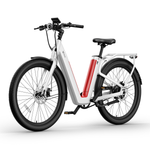
The good: 90-mile range, belt drive so no grease and no rust, integrated everything, solid build quality, 2-year warranty.
The annoying: Heavy at 70.5 lbs. Not folding. The throttle is a thumb lever instead of a twist grip. Limited color options.
Who should buy it: Daily commuters who want zero maintenance headaches. People who ride in all weather and don’t want to deal with chain rust. Anyone who’s tired of range anxiety.
Check the NIU BQi-C3 Pro at NIU
Premium Pick: Segway Xafari
If your commute involves hills, rough roads, or you just want the absolute smoothest ride, the Segway Xafari is the answer. This thing is a tank. Full suspension, 750W motor with 80 Newton-meters of torque, hydraulic disc brakes, and enough power to climb grades that would make most e-bikes cry.
It also has tech that actually works, not just checkboxes on a spec sheet. Apple Find My integration, so you can locate it if someone walks off with it. An app that tracks your rides and integrates with Apple Health and Google Fit. AirLock keyless entry, so you don’t fumble with keys. And a 936Wh battery that delivers up to 88 miles of range.
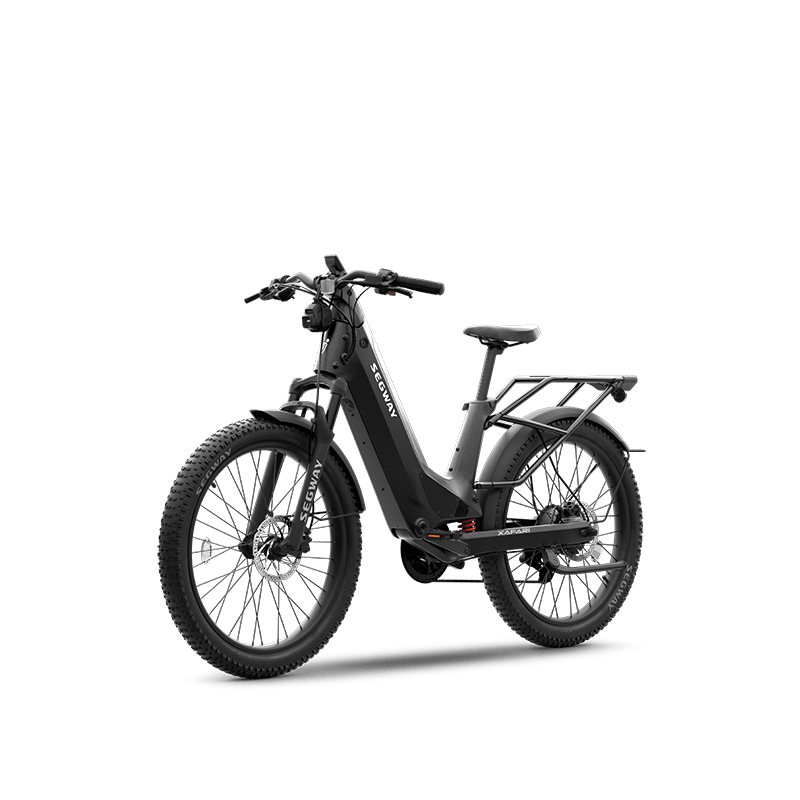
The good: Full suspension, massive torque, 88-mile range, smart features that actually work, Shimano 8-speed, hydraulic brakes.
The annoying: Heavy at 85 to 92 lbs. Expensive. The one-size frame won’t fit riders under 5’4″ or over 6’2″ well.
Who should buy it: Commuters who face serious hills or rough roads. Tech-forward riders who want GPS tracking and smart features. People who want a premium ride and can handle the weight.
Check the Segway Xafari at Segway
Power Pick: Jasion X Hunter PRO
If you want raw power in a package that still folds, the Jasion X Hunter PRO is ridiculous in the best way. Eighteen hundred watts of peak motor power on a foldable e-bike. It tops out around 28 mph and the fat tires eat up gravel, sand, and potholes like they’re not even there.
The 720Wh removable battery gives you up to 80 miles of range on pedal assist, which is honestly more than most people will ever need in a week of commuting. It folds down, but fair warning: at nearly 70 pounds, “folding” means it fits in your trunk, not that you’re carrying it up stairs.
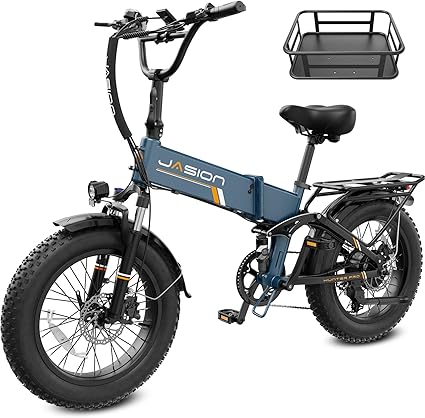
The good: Insane power for the price, fat tires handle any terrain, folds for transport, 80-mile range, under 1,200 bucks.
The annoying: Heavy. The folding mechanism is clunky. The seat isn’t great for long rides. Assembly instructions are written by someone who hates you.
Who should buy it: People who want maximum power without the premium price tag. Riders who tackle mixed terrain. Anyone who needs a folding e-bike that doesn’t feel like a toy.
Check the Jasion X Hunter PRO on Amazon
Range King: FREESKY Ranger AIR
One hundred and five miles of range. Let that sink in. Most e-bikes claim 40 to 60 miles. The FREESKY Ranger AIR nearly doubles that with its dual-battery setup and efficient dual motor system that intelligently switches between single and dual motor mode to conserve power.
The dual motors put out 3,500 watts and 200 Newton-meters of torque. Full suspension, hydraulic disc brakes, a smart LCD display with NFC keyless unlock, and seven riding modes. This is an e-bike that’s trying to be a motorcycle and honestly, it’s not far off.
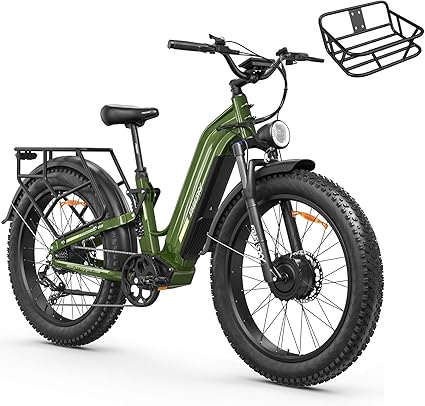
The good: 105-mile range, 3,500W dual motor, full suspension, NFC unlock, AI power management, 7 riding modes.
The annoying: Only 2 reviews on Amazon so far, 5.0 stars but still. Heavy. The “AI” power management is marketing speak for basic load balancing. New brand, limited track record.
Who should buy it: Long-distance commuters who never want range anxiety. Hill climbers. Anyone who wants the most tech they can get under a thousand dollars.
Check the FREESKY Ranger AIR on Amazon
The Verdict by Scenario
Replacing a car? Buy an e-bike. The math works, the convenience is real, and your wallet will thank you within six months.
Long commute, 10+ miles? Buy an e-bike. The difference between hating your commute and enjoying it is about five hundred watts of motor assistance.
Short commute, under 3 miles? Buy a regular bike. An e-bike is overkill and the ongoing costs aren’t worth it.
Somewhere in between? Think hard about it. A folding e-bike like the Hiboy works. A full-size e-bike that weighs sixty pounds is going to be a daily annoyance if you need to store it somewhere awkward.
Tight budget? E-bike works if you actually commit to using low assist levels. If you’re the type who’ll just crank it to max and coast, buy a regular bike and use the savings for better gear.
Found this useful? Share it with a fellow rider.
🚲 Get LaneSpotter in Your Inbox
Weekly riding tips, gear deals, and no-BS reviews. No spam, unsubscribe anytime.
Join 500+ riders who skip the marketing fluff
Leave a Reply